
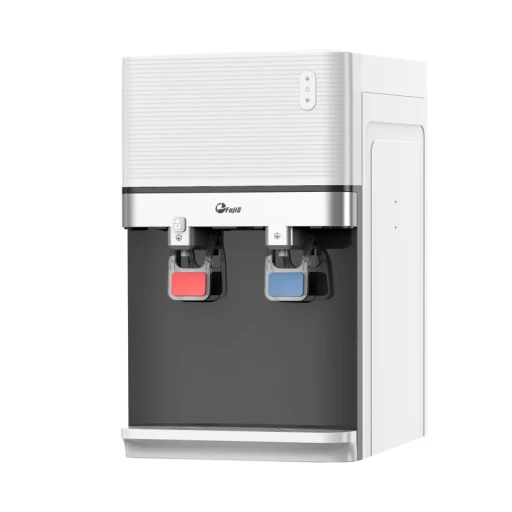

The market currently offers a vast array of hot and cold water dispensers, leaving school administrators wondering which type to choose to meet high usage demands while ensuring safety, cost-effectiveness, and durability. This article will provide information on important criteria to help schools make the most informed decision.
1. Why should schools equip themselves with dedicated hot and cold water dispensers?
Before delving into the details of different types of water dispensers, let's look at the outstanding benefits a hot and cold water dispenser for schools offers:
Ensuring student health: Clean drinking water is the foundation of health. Hot and cold water dispensers often integrate modern filtration systems, removing bacteria and impurities, providing pure and safe water. Hot water can be used to prepare milk, instant noodles (for boarding students), or simply warm water on cold days. Cold water helps to quickly cool down after stressful classes or during physical activity breaks.
Convenience and time saving: Instead of boiling water or buying expensive and time-consuming bottled water, students and teachers can easily get drinking water anytime.
Creating a modern learning environment: Equipping schools with hot and cold water dispensers demonstrates the school's concern for students' well-being, contributing to improving the image and quality of education.
Reducing plastic waste: Using hot and cold water dispensers significantly reduces the amount of single-use plastic bottles, contributing to environmental protection.
Cost control: In the long run, the cost of using a hot and cold water dispenser (electricity, filter replacement costs) will be much lower than regularly buying bottled water for a large number of students.
2. Important criteria when choosing a hot and cold water dispenser for schools
To choose the most suitable hot and cold water dispenser for a school, the school needs to carefully consider the following criteria:
2.1. Capacity and Demand Response
This is a crucial selection factor because schools have a large number of students and teachers, requiring continuous water use. A water dispenser with insufficient capacity will not be able to meet the demand, leading to running out of hot/cold water or long waiting times.
Cooling/Heating Capacity: It is recommended to choose models with a cooling capacity of 90W or more and a heating capacity of 450W or more. For large schools, prioritize models with higher capacity or consider installing multiple water dispensers in different locations.
Tank Capacity: The larger the hot and cold water tanks, the greater the continuous service capacity. A cold water tank capacity of 2-4 liters and a hot water tank capacity of 1-2 liters is suitable for basic needs. However, for schools, a larger capacity or an instant heating/cooling system is recommended. 2.2. Heating/Cooling Speed: Some water dispensers have fast cooling or super-fast heating technology, which is very suitable for environments with many users.
2.3. Cooling Technology
There are two common cooling technologies in hot and cold water dispensers:
Block Cooling: Uses gas compression technology similar to refrigerators, providing deep, fast, and stable cooling. This technology is ideal for schools because it can meet the needs of continuous, high-intensity use.
Electronic Chip Cooling (Semiconductor Chip): Usually cheaper and more compact, but the cooling capacity is not as deep as Block Cooling and the cooling speed is slower. Suitable for low or intermittent use. Not recommended for school environments.
2.4. Water Bottle Placement and Design
Upside-down bottle placement: Common, easy to replace water bottles, but requires lifting the bottles to a high place, and may not be aesthetically pleasing.
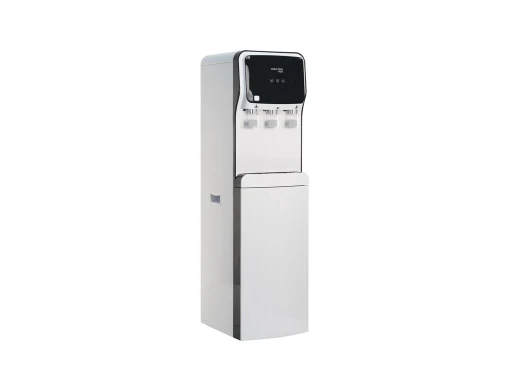
2.4. Concealed Water Tank (Suction Tank): The water tank is hidden inside the machine body, providing high aesthetics and easy replacement (no need to lift it up). This is an ideal choice for schools, especially in teacher areas or reception halls.
2.5. Materials and Durability
Outer Casing: Choose an outer casing made of high-grade plastic or stainless steel to ensure durability, impact resistance, and easy cleaning.
Water Tank: Prioritize a water tank made of 304 stainless steel, which is safe for health and corrosion-resistant.
Water Dispenser Faucet: The faucet should be made of virgin plastic or stainless steel, sturdy, and leak-proof.
2.6. Safety and Convenience Features
Hot Water Faucet Lock: An extremely important feature for schools, especially those with young students. The hot water faucet lock helps prevent accidental burns.
Overheating Sensor: Automatically shuts off when the water temperature is too high, protecting the equipment and ensuring user safety.
Power saving mode: Automatically shuts off when not in use or at night, helping to reduce electricity costs.
Indicator lights: Show hot/cold status, low water level, filter replacement needed, etc.
Drip tray: Easy to remove and clean.
2.7. Brand and Warranty
Reputable brand: Choose products from large, well-known brands in the market. These brands usually have quality products and good after-sales service.
Warranty: The longer the warranty period, the better, demonstrating the manufacturer's confidence in the product quality.
Filter replacement service: Prioritize units that offer regular filter replacement services, ensuring water quality is always maintained.
3. Types of hot and cold water dispensers